
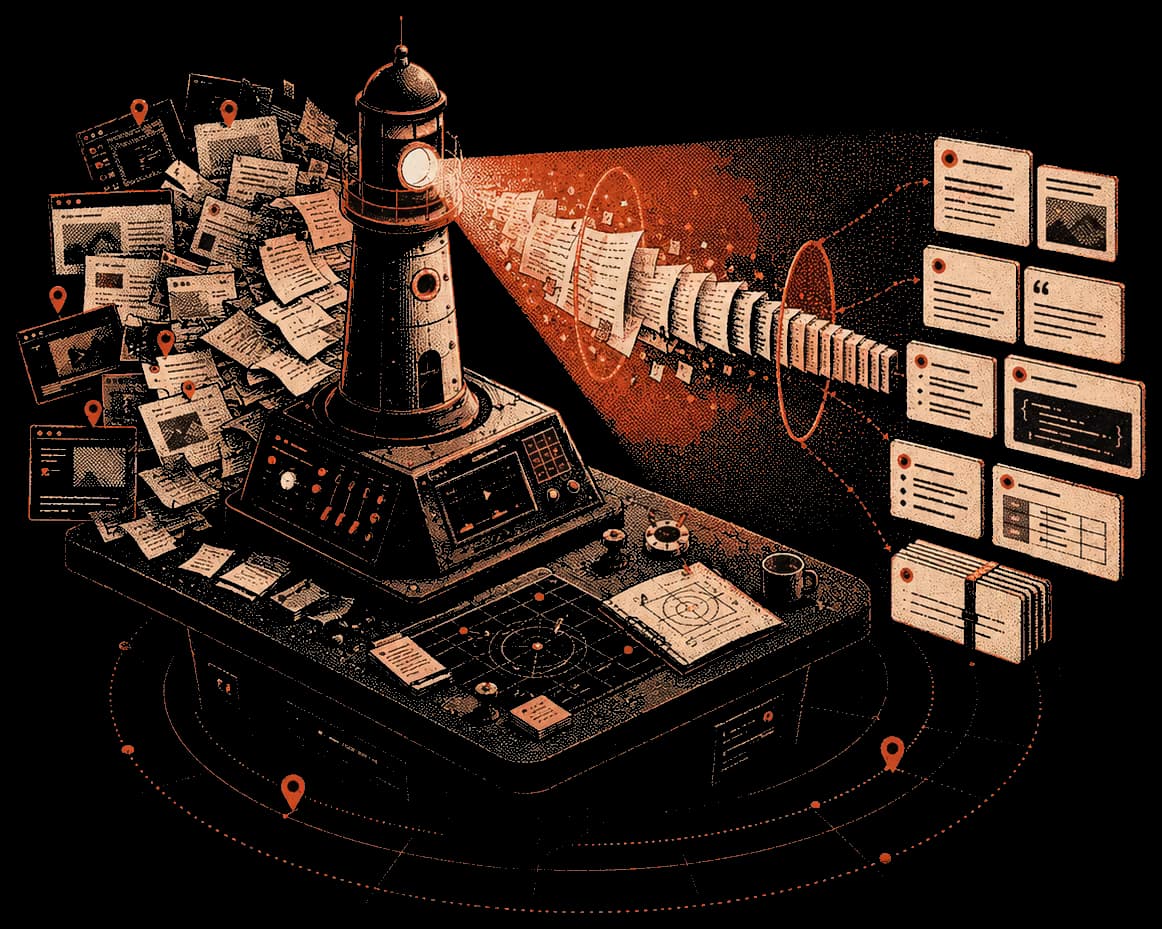
Sailor Search is an AI-native search API for agentic systems and research workflows. The system centers on predictable API behavior, source-aware results, clean markdown output, and data shaping that keeps downstream LLM workflows efficient. The positioning is deliberate: it is search built for agents, not browsers, and the response is treated as the product.
The Product Contract
Search APIs for agents need to do more than return links. They need to provide structured evidence, clean extracted content, and enough metadata for another system to judge source quality. A human can open five tabs and reconcile them; an agent usually receives one response and has to make the next decision from it.
The backend contract was designed around predictable responses: clear result shape, source-aware fields, extraction status, and compact content that can be passed into RAG and research flows without wasting context.
Approach
Two design choices did most of the work. First, optimize for downstream reasoning instead of human browsing: return clean markdown rather than raw HTML, so hierarchy and links survive while layout noise is stripped — which is where most of the token reduction comes from. Second, make uncertainty explicit: if a result is stale, blocked, or only partially extracted, the API says so directly rather than emitting confident-looking but thin content.
Behind the API, multiple engines and social-native sources are blended into a single response shape, so callers integrate once and let the routing layer decide where a query is best answered. Caching and compact output keep latency and token cost low enough for tight agent loops.
What I Worked On
- Designed backend and infrastructure for an AI-native search API.
- Implemented clean markdown output, deep search, enrichment, and token compression.
- Built foundations for predictable API behavior, source-aware results, and production search workflows.
Outcome and Durable Shape
The important decision was to optimize for downstream reasoning instead of human browsing alone. Clean markdown, compact context, and explicit source metadata made the API easier for agents to inspect, cite, compress, and recover from. That made the system feel less like a search wrapper and more like a retrieval surface built for production AI workloads.