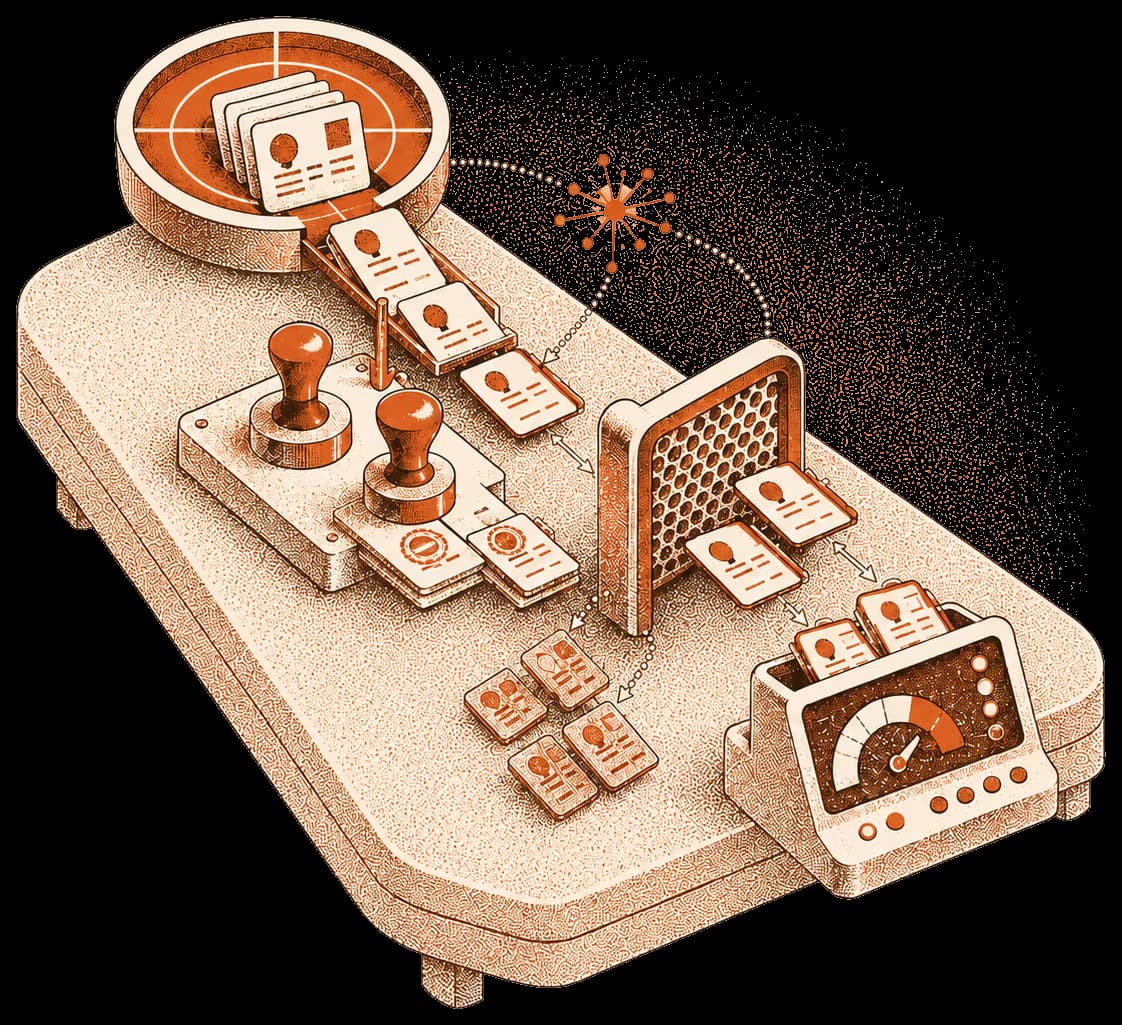
Oppora AI is an AI sales SaaS product built around end-to-end outbound workflows. The work centered on backend foundations that reduced dependency on third-party tooling while supporting lead search, enrichment, deliverability, warmup, and assisted campaign execution. The product runs as a sequence of cooperating AI agents — company finder, lead finder, email finder, enrichment, verification, scoring, campaign, and reply handling — that have to behave like one coherent system rather than eight loosely glued integrations.
The Operating Problem
Outbound teams often stitch together separate services for search, enrichment, verification, warmup, copy assistance, and campaign execution. That can work early, but it becomes brittle once the workflow has to behave like one product. Each vendor has its own latency profile, failure mode, and rate limit, and the moment one of them degrades, the whole pipeline produces results that look confident but are quietly wrong.
The backend needed to give the product a more coherent execution layer. Search and enrichment had to feed campaign decisions. Deliverability checks needed to be part of the workflow instead of an afterthought. AI assistance had to improve content without making the system opaque.
Approach
I treated the outbound pipeline as a state machine, not a script. Each lead moves through discovery, enrichment, verification, and campaign stages with explicit transitions, so the system always knows where a record is and what is allowed to happen next. Long-running and rate-limited work runs through Celery and Redis as background jobs with retries and backoff, which keeps the API responsive and makes vendor hiccups recoverable instead of fatal.
For the parts of the loop that defined product trust — email verification, deliverability, and warmup — the goal was to own enough of the workflow to expose clear status and limits, rather than forwarding a black-box vendor response straight to the user. LLM-assisted steps (LangChain over GPT) were wrapped in the same predictable contract: structured inputs, structured outputs, and a fallback path when a model call is slow or low-confidence.
What I Worked On
- Built backend infrastructure for AI sales workflows and assisted campaign execution.
- Implemented email verification, lead search, enrichment, and deliverability tooling to reduce reliance on third-party services.
- Developed warmup, outreach, and AI-enhanced content improvement workflows behind a single workflow contract.
Outcome and Durable Shape
The useful pattern was treating each external dependency as replaceable infrastructure rather than the center of the product. The product became easier to evolve when the backend owned the workflow contract, the state transitions, and the failure boundaries. That let the AI features sit inside a predictable system instead of becoming a separate layer of magic — and it let the product expose itself through both a REST API and an MCP interface without rewriting the core.