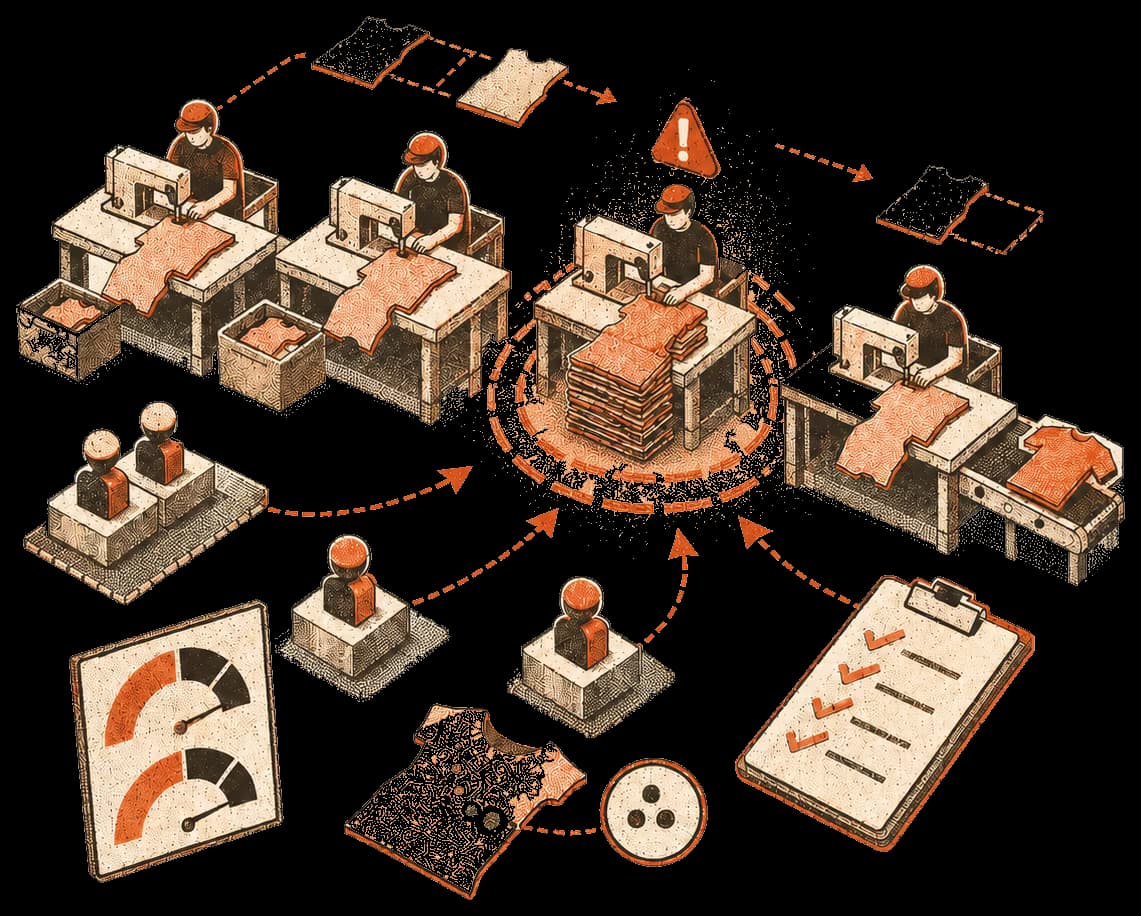
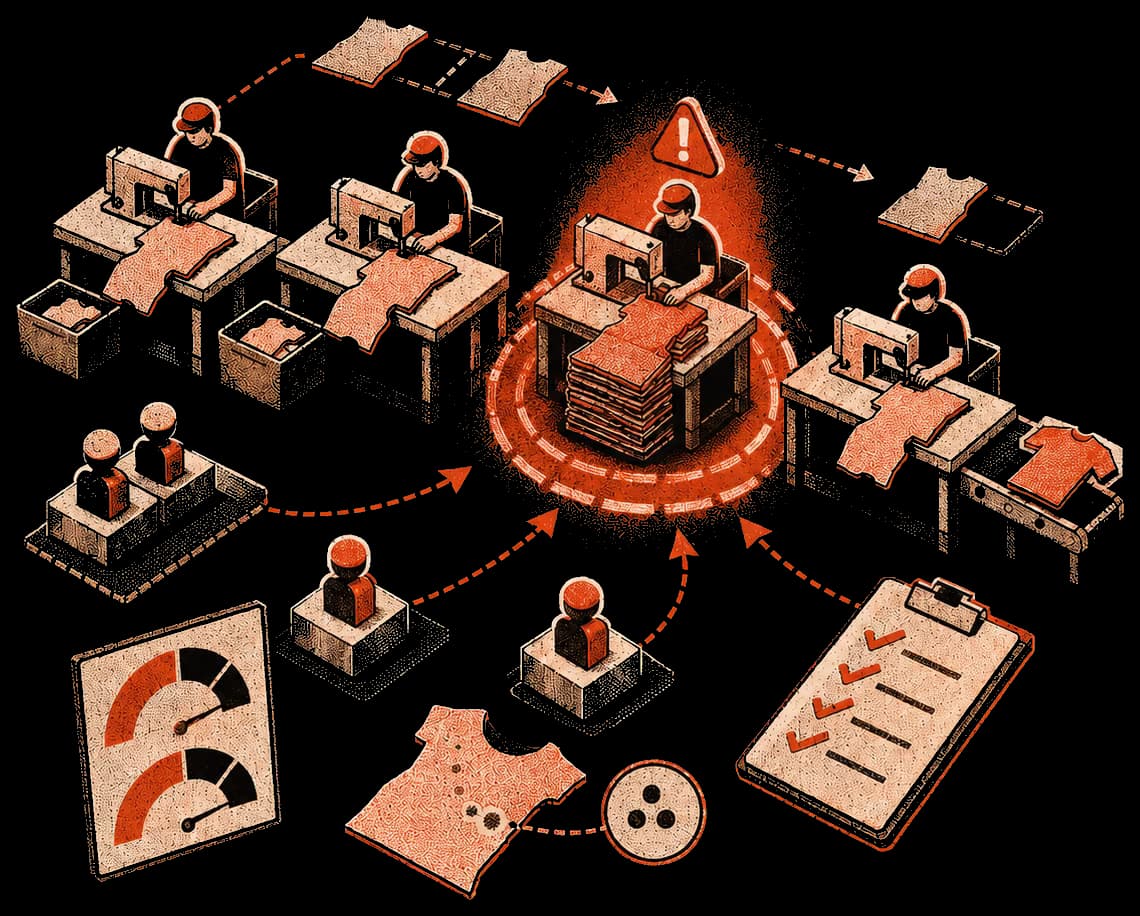
ProTrac shifted RMG (ready-made garments) production visibility from delayed reporting toward real-time operational signals. The system helped floor and management teams identify bottlenecks, choke points, DHU (defects per hundred units) issues, and plan-vs-actual gaps while there was still time to act on them.
The Visibility Problem
Production teams do not only need reports after the fact. They need timely signals that can change what happens on the floor while there is still time to respond. By the time a daily report shows a line fell behind, the shift is often already lost.
The product focused on surfacing operational choke points and turning scattered production updates into a shared picture of progress, risk, and quality.
Approach
The system models the floor as lines, processes, and orders, and continuously compares actual output against plan. Instead of waiting for end-of-day reconciliation, it detects drift as it happens — a process falling behind, a defect rate climbing, a choke point forming — and surfaces it as a specific, current signal tied to a place on the floor. Redis-backed updates keep the shared view fresh enough for supervisors to trust it during a shift, and the dashboards were designed to point at the next action rather than just display numbers.
What I Worked On
- Built production-floor tracking for bottlenecks, choke points, DHU, and plan-vs-actual gaps.
- Moved production visibility from delayed reports toward real-time action signals.
- Designed dashboards and backend workflows that connected factory data with stakeholder decision-making.
Outcome and Durable Shape
The lasting lesson was that dashboards are only useful when they shorten the path from signal to action. A clean backend workflow gave teams enough shared context to spot the issue, understand the severity, and decide what should happen next — on the floor, in time to matter.